Annie Dillard, Pulitzer Prize-Winning Author of Pilgrim at Tinker Creek, Dies at 81

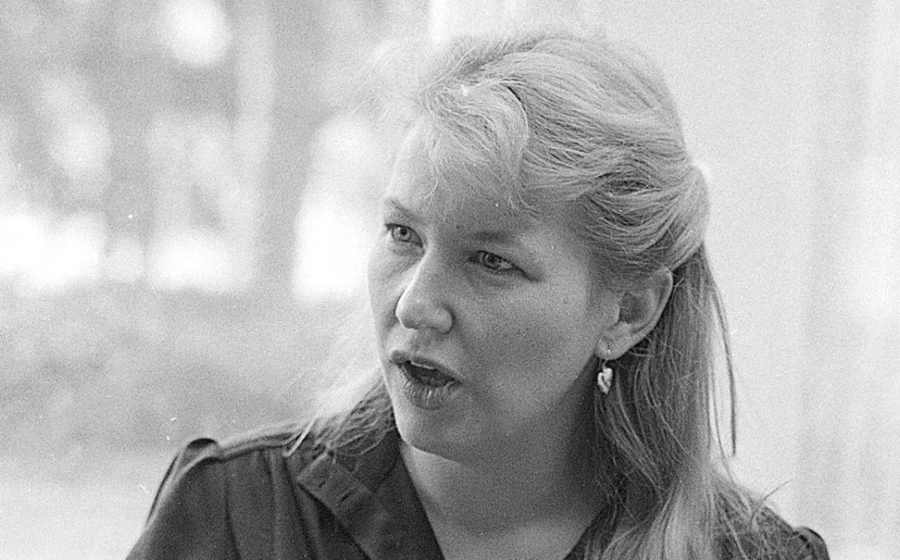
Image Via: NPR
Annie Dillard, the Pulitzer Prize-winning author whose 1974 book Pilgrim at Tinker Creek established her as one of the most distinctive voices in American letters, died Tuesday at her home in South Wellfleet, Massachusetts. She was 81.
Her death was confirmed by her literary executor, Maggie Nelson, according to the Seattle Times and the Guardian. No cause of death was immediately released.
A Career Defined by Observation and Reflection
Dillard was born Meta Ann Doak on April 30, 1945, in Pittsburgh, Pennsylvania. She earned bachelor’s and master’s degrees from Hollins University in Roanoke, Virginia, where she studied Henry David Thoreau for her master’s thesis.
Pilgrim at Tinker Creek, published when Dillard was 28, was an extended meditation on the natural world surrounding her Virginia home. The book won the 1975 Pulitzer Prize for general nonfiction and drew comparisons to Thoreau’s Walden.
Reviewing the book for The New York Times, Eudora Welty wrote that Dillard was ‘the only person in her book, substantially the only one in her world.’ Welty added, ‘Speaking of the universe very often, she is yet self-surrounded, and, beyond that, book-surrounded.’
Range and Recognition
Dillard went on to publish poetry, essays, journalism, meditations on religion, literary theory, two novels and a bestselling autobiography. Her other notable works included Holy the Firm (1977), Teaching a Stone to Talk (1982), An American Childhood (1987), The Writing Life (1989), The Living (1992), For the Time Being (1999) and The Maytrees (2007).
Her essay Total Eclipse, about witnessing a solar eclipse in Washington state in 1979, was included in The Best American Essays of the Century in 2000. In 1998, Pilgrim at Tinker Creek was named to the Modern Library’s list of the 100 best nonfiction books.
Dillard received the National Humanities Medal in 2014. She taught at Wesleyan University in Middletown, Connecticut, for more than 20 years before retiring.
Reflections on Writing and Nature
Dillard rejected the label of nature writer, considering herself a theologian exploring the mystery of God and the duality of reality. Speaking to NPR’s Weekend Edition in 2016, she said, ‘Once you write about something, you’ve destroyed it. You no longer have the memory. You only have the memory of what you’ve written.’
In The Writing Life, she wrote, ‘How we spend our days is, of course, how we spend our lives.’ The book was only a little over 100 pages long, reflecting her determination to pare away everything extraneous in her work.
Personal Life
Dillard was married three times. Her first marriage, to creative writing instructor Richard Dillard, ended in divorce. She later married anthropologist Gary Clevidence, with whom she had a daughter, Cody Rose, in 1984. That marriage also ended in divorce.
Her third husband was historical biographer Robert D. Richardson Jr., whom she married after sending him a fan letter about his book Henry Thoreau: A Life of the Mind. They were married for 32 years until his death in 2020.
Dillard spent much of her later life in South Wellfleet, Massachusetts. A complete list of survivors was not immediately available.
Her papers are held at the Beinecke Library at Yale University. Funeral arrangements have not been announced.