Democrats Eye Midterm Gains as Republican Control Wanes
With over 31 million early votes cast, Democrats look poised to challenge the Republican majority in Congress, though analysts caution that a significant blue wave remains uncertain.


With only one week remaining until the midterm elections, the United States stands on the precipice of a significant political shift that could strip the Republican Party of its legislative control in Washington. While expectations are high for a Democratic resurgence, political experts emphasize that the outcome remains fluid in a season defined by volatile polling, complex redistricting maps, and significant independent campaign spending. It’s far too early to size up any Democratic wave.
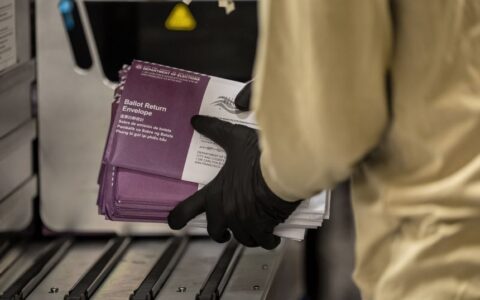
More than 31 million ballots have already been cast through early voting, reflecting intense engagement ahead of election day. Political observers largely anticipate that Democrats will successfully challenge the current Republican majority to reclaim the House of Representatives. Such a result would function as a rebuke to President Donald Trump, who has struggled to address public concerns regarding the high cost of living, including steep prices for groceries, gasoline, and housing—campaign promises that remain unfulfilled since 2024. Despite this, Democrats are wary of overconfidence; years of aggressive gerrymandering and the impact of Trump-led redistricting efforts mean that of the 435 available House seats, only about four dozen are considered genuinely competitive. Still, almost everyone involved in politics expects Democrats to erase the Republican majority and win back the House, in a classic rebuke to a sitting president who seems to have forgotten he promised to cut the cost of. Redrawn districts, a gusher of outside cash — including hundreds of millions of dollars of GOP funding from Elon Musk — and ambiguity over who will turn up to vote, there’s no guarantee there’ll even be one in an election season characterized by political volatility. And the wrinkles of the US political system mean that polls showing a wide Democratic lead on the generic congressional ballot might translate into a more equivocal result than expected. And Democrats are trying to do something spectacular and rare on what was long considered a prohibitive Senate map this cycle. They need an unlikely winning streak through solid GOP territory to find the net gain of four seats needed for the majority. And Trump’s campaign blitz is mostly focused on red America as he tries to rescue them. Cindy Hyde-Smith is facing an unexpectedly strong Democratic challenge. None of this proves that Democrats are poised for a victory lap.
The battle for the Senate remains equally tight, with approximately 10 key races currently deadlocked. Hakeem Jeffries, likely to become speaker in a Democratic-majority House, expressed confidence last week, telling reporters that his party is “very likely” to regain control and noting that the current political climate is “clearly on our side.” However, the path to a Senate majority is narrow and requires Democrats to win a string of races in traditionally solid Republican territories. For example, Texas—which has not elected a Democratic senator since 1988—was recently ranked by a major political analysis as the fifth most likely seat to flip, underscoring the massive scale of the challenge. The 10 or so races that will meanwhile decide the Senate’s destiny are mostly neck-and-neck.
Signs of strain within the Republican coalition have become increasingly visible. Trump has spent the final week holding rallies in safely Republican areas, such as a recent stop in Mississippi, to stabilize support. “You know, I’m here because Cindy’s doing great, but I just got to make sure. I can’t take a chance,” the president remarked during the event. Reports indicate that voter turnout among younger Republicans in states like Georgia, Iowa, and North Carolina is currently lagging behind previous election cycles, and there is little evidence that the president’s pledge of a $5,000 payout to American adults has gained significant traction among the electorate. On Monday, for example, he held a rally in Mississippi, where he won by 23 points two years ago. Pundits may be increasingly bullish that Democrats will give Republicans a shellacking. What is the purpose of speculating, but at this point. Voters will take part in a noble biennial ritual next Tuesday to deliver the only verdict that matters, and after years of apprehension over American democracy. In 2020, to deny voters’ right to choose their leaders after an election he lost, and they recall the president’s previous bid. The rout could become reality, if networks make an early call for Democrats in a state where Trump romped home by 11 points two years ago. But given Trump’s past triumphs, Democrats would be foolish to take a big night for granted. This means Democrats could run close in all of them but still miss most of their targets.
The president’s recent rhetoric has also stirred controversy. Trump has explicitly targeted Michigan Senate candidate Abdul El-Sayed, calling him a supporter of “terrorists” and suggesting the Muslim politician should be required to pass through a metal detector before entering the Senate. Simultaneously, the administration appears to be bracing for potential voting disputes, with preemptive legal strategies emerging in Alaska and California that echo previous efforts to contest election results.
Economic frustrations continue to drive voter sentiment, exacerbated by ongoing international conflicts and the president’s tariff policies. With gasoline prices averaging over $4 per gallon, recent comments from the White House celebrating oil company profits have done little to soften the blow for voters struggling with inflation. Instead of focusing on household budgets, Trump has faced criticism for using campaign rallies to discuss personal grievances and trivial subjects.
While Democrats see momentum in specific races, such as in North Carolina and Ohio, they face potential obstacles in other regions. The outcome in Michigan is particularly critical, as the contest for the seat being vacated by Sen. Gary Peters has become a tight race, testing the party’s strength. As the final week of campaigning unfolds, both parties are operating under the weight of an unpredictable environment, with Democrats seeking to maximize their gains while Republicans scramble to defend their narrow margins in a rapidly changing political landscape.