Scientists Confirm First New Living Cat Species in Over a Century With Leopardus tilcayo Discovery

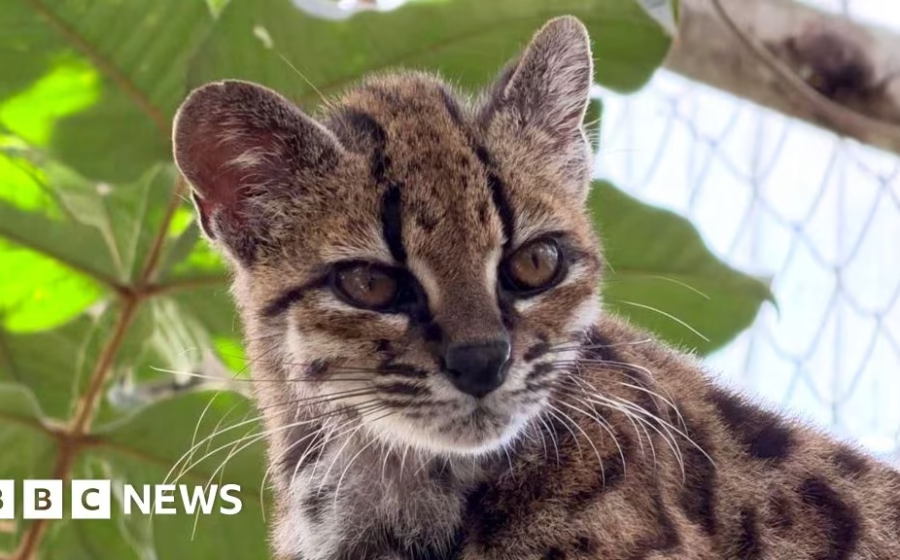
Image Via: BBC
Researchers have formally described Leopardus tilcayo, a small spotted wild cat from Bolivia’s Yungas cloud forest, marking the first new living cat species named and described in more than 100 years. The findings were published Thursday, September 17, 2026, in the journal Current Biology.
The cat, known locally as the tilcayo, measures about 46 centimeters (18 inches) long and weighs approximately 1.4 kilograms (3 pounds), making it smaller than the average domestic cat. It has light brown fur with irregularly shaped rosettes, short round ears, and long whiskers.
A Decade-Long Investigation
The discovery traces back to 2016, when Paola Nogales-Ascarrunz, a National Geographic Explorer and founder of the Bolivian Felids Research Program, received a call from a wildlife sanctuary about what staff described as ‘a weird cat.’ A local man had found the animal as a kitten near a forest and kept it at his home for about a year before surrendering it to the Senda Verde wildlife sanctuary.
Nogales-Ascarrunz visited the sanctuary and photographed the animal extensively. ‘I took a hundred pictures of it,’ she told National Geographic. ‘I was so fascinated.’
At the time, she assumed the cat belonged to Leopardus tigrinus, a species described in 1775 and presumed to range across much of South America. But in 2019, while preparing a booklet on Bolivia’s cat species, she noticed the cat’s rosettes were much larger than those of Brazilian tiger cats. ‘This is so wrong,’ she recalled thinking.
Genetic Analysis Confirms Distinct Lineage
Nogales-Ascarrunz later collaborated with Eduardo Eizirik, a geneticist at Pontifical Catholic University of Rio Grande do Sul in Brazil, and Jonas Lescroart, an evolutionary biologist at the University of Antwerp in Belgium. The team analyzed DNA from 38 cats sampled across several South American countries, including eight museum specimens.
The results showed that tiger cats, previously considered a single species, are actually five genetically distinct species. Genetic analysis suggested the Tilcayo lineage separated from other tiger cats about 1.4 million years ago.
‘We never expected this Bolivian tiger cat to be a separate species, and no one had ever proposed it as a different animal, subspecies or otherwise,’ Lescroart told Reuters.
Lescroart added: ‘The more differences in their DNA, the longer the time that we estimate those lineages to have been physically separated.’ He noted that such a genetic gap is generally considered a species-level divide in cats.
The research team also described a new tiger cat subspecies in Peru’s Yungas, naming it Leopardus tigrinus antisuyo after Antisuyu, the region of the old Inca Empire that included the area it inhabits.
Conservation Implications
The International Union for Conservation of Nature currently treats tiger cats as two vulnerable species with declining populations. The researchers have shared their findings with the IUCN, whose upcoming review will assess the five lineages separately.
Lescroart said this could give a more accurate picture of extinction risk and that species such as the Tilcayo could potentially be considered endangered when assessed on their own.
Little is currently known about the tilcayo’s biology and lifestyle. Scat samples suggest small rodents may form part of its diet, and camera-trap evidence indicates it could be more active at night, according to Nogales-Ascarrunz.
‘Our information at this moment is limited to the two live individuals that we examined, and a small number of camera-trap records,’ Lescroart said.
One of the live cats is a 10-year-old male that has lived at the Senda Verde Wildlife Sanctuary since 2017 after being kept by a local family.
Call for Further Discovery
Nogales-Ascarrunz said the methods used to identify the new species could help uncover others. ‘Even in the cats, there are things out there that are undescribed, things that people haven’t found yet,’ she told National Geographic. ‘So let’s go out and find them and protect them.’
The Yungas cloud forest faces threats from deforestation, agricultural expansion, forest fires, and mining. Researchers said the formal recognition of the tilcayo as a distinct species could help support conservation efforts in the region.
As of September 18, 2026, the study has been published in Current Biology, and the IUCN review of the five tiger cat lineages is pending.