Porsha Williams Reveals Emergency Partial Hysterectomy After Doctors Found 21 Fibroids

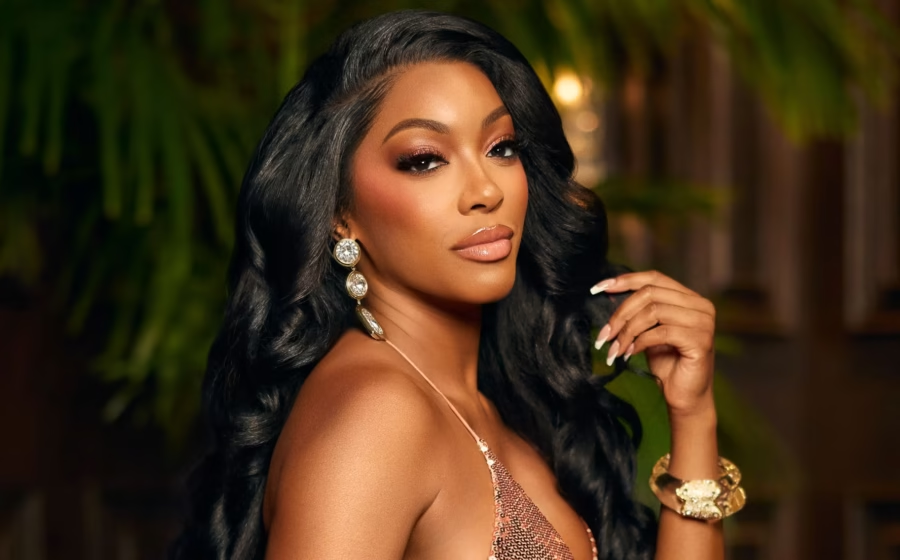
Image Via: bravotv
Porsha Williams underwent an emergency partial hysterectomy in May 2026 after doctors discovered 21 uterine fibroids, including one the size of a cantaloupe, the Real Housewives of Atlanta star revealed on September 18.
Williams shared her story in an exclusive interview on CBS Mornings with Gayle King and in a first-person essay published by Glamour. She said the surgery saved her life but also ended her ability to carry more children.
The discovery came during a routine visit to a fertility doctor. Williams had accompanied a friend who was exploring egg freezing and decided to ask for a quick ultrasound herself. She had previously been treated for fibroids and believed they were gone.
During the exam, the doctor went silent while looking at the screen. Williams said she saw dark space and then circular lines. ‘Not again. Not again. They had come back,’ she recalled thinking.
She was referred to a specialist and sent for an MRI the same afternoon. The imaging showed more than 15 large fibroids, along with endometriosis and another diagnosis involving the uterine lining. Surgery was scheduled for about two weeks later.
During the procedure, doctors found 21 fibroids in total. Williams kept her ovaries but lost her uterus. She said the largest fibroid was the size of a cantaloupe and had grown large enough to close off more than 60 percent of her birth canal.
Williams told King that the speed of the diagnosis and surgery was disorienting. ‘It all happened so fast. It really didn’t hit me until I woke up in the hospital bed,’ she said.
In her Glamour essay, Williams wrote about the emotional impact of losing her uterus. ‘I woke up after the surgery and thought, A part of me is gone,’ she wrote. ‘Fibroids aren’t something we usually talk about as women, and neither are hysterectomies. There’s a stigma to it, as if you’re somehow less of a woman without your uterus.’
Williams had been dealing with fibroids since her late 20s. She learned she had them the same day she found out she was pregnant with her first child. The fibroid outgrew the pregnancy, and she suffered a miscarriage at four months. She later underwent a myomectomy, but the fibroids returned during her pregnancy with her daughter, Pilar, who was born in 2019.
After giving birth, Williams had a procedure called uterine fibroid embolization to shrink the fibroids without removing her uterus. She said the treatment seemed to work for a time, easing her heavy periods and back pain. But after her divorce, symptoms returned, including fatigue, migraines, and frequent urination. She attributed them to perimenopause.
She said she now understands that the fibroids were behind many of those symptoms. ‘I didn’t have a choice about the hysterectomy, but it saved my life. My quality of life has improved 100% since,’ she wrote. ‘I hadn’t realized the fibroids were behind my migraines, my low iron levels, or how stressed my body had been just from everyday life.’
Williams is sharing her story to encourage other women to advocate for themselves. She told King that women should not diagnose themselves and should ask doctors to check for fibroids if they have symptoms. ‘We have to stop diagnosing ourselves. There are so many different things when it comes to a woman that you need to get checked, and we need to learn to advocate for ourselves,’ she said.
Uterine fibroids are common, noncancerous growths of the uterus. According to the Black Women’s Health Imperative, roughly 80 percent of Black women develop fibroids by age 50, compared with about 70 percent of white women. Black women are also two to three times more likely to undergo a hysterectomy because of them.
Williams, 45, is a mother to her 7-year-old daughter, Pilar Jhena, whom she shares with ex-fiancé Dennis McKinley. She said she had always wanted more children and had been considering having another baby before the diagnosis. She wrote that she grieved the loss of that possibility but feels grateful for her daughter. ‘I’ve always called her my lifesaver, since she gave me my purpose, and now that feels even more true,’ she wrote.
The CBS Mornings interview aired on September 18, 2026. Williams’ Glamour essay was published the same day. The story was first reported by People, Page Six, and other outlets on September 18. No further updates on Williams’ recovery or future plans have been announced.